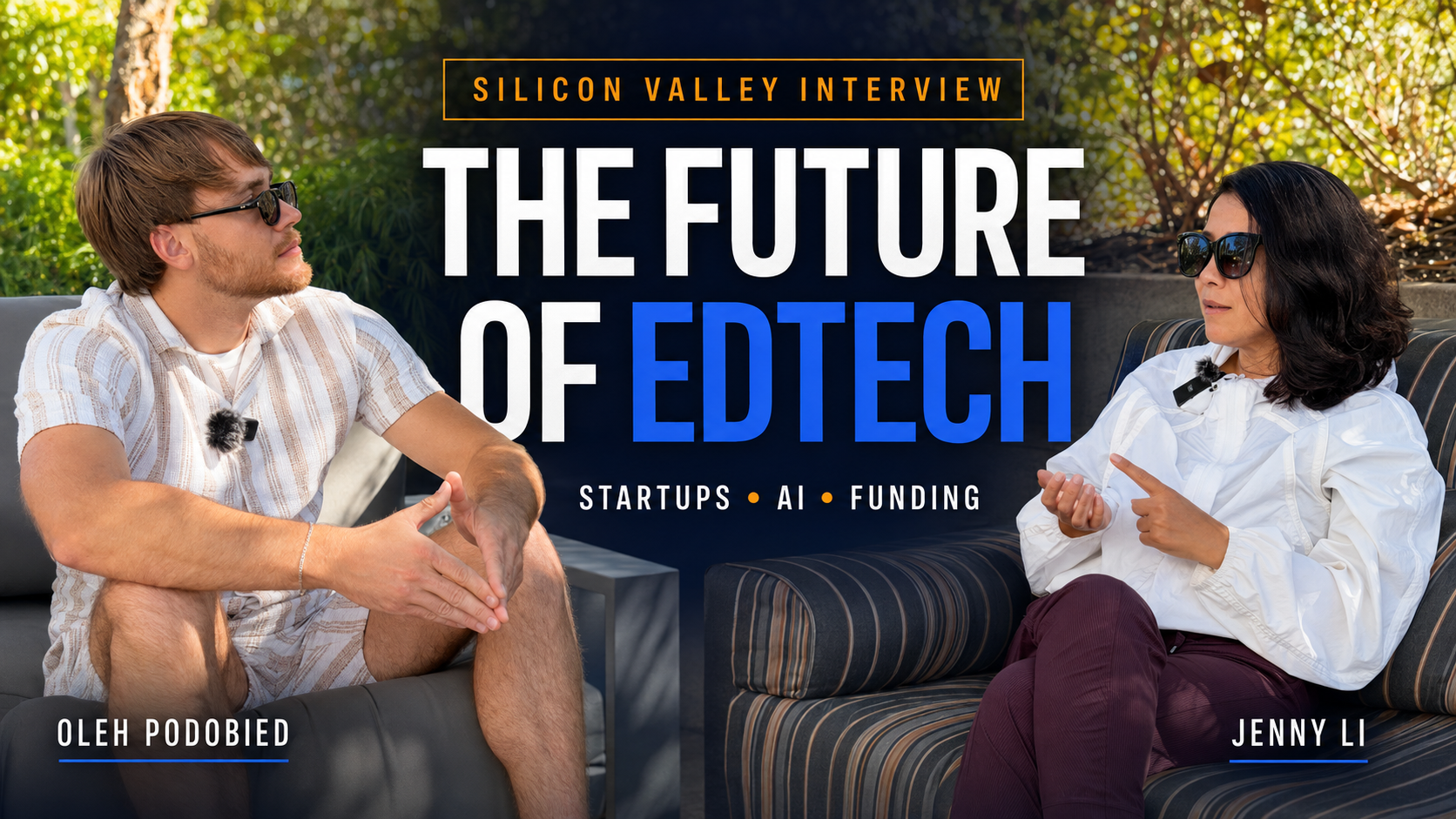
ITCAPITAL Founder Oleh Podobied Discusses the Future of EdTech, AI, and Venture Capital
A Silicon Valley conversation with Jenny Li about education, artificial intelligence, startup funding, global markets, and the skills people will need in the next economy.
Technology is evolving faster than ever. However, the systems responsible for preparing people for the future often change much more slowly.
This challenge became the starting point for a new Silicon Valley interview between Oleh Podobied, Founder of ITCAPITAL, Founder & CEO of EDCAPIT, and President of ITCAPITAL Ventures, and Jenny Li, Founder & CEO of GES Ventures and President of GES International Education Group.
Together, they examined the future of education through the perspectives of technology founders, education leaders, and participants in the venture capital ecosystem.
Their conversation covered EdTech, artificial intelligence, startup investment, government grants, international markets, and the transformation of learning over the next 5–10 years.
Watch the Full Silicon Valley Interview
A Conversation at the Intersection of Technology, Education, and Capital
Every major technology cycle creates new products, companies, and industries.
At the same time, it changes the skills people need to remain competitive.
Artificial intelligence is already transforming software development, marketing, finance, manufacturing, healthcare, education, and many other sectors. As a result, businesses need new tools, while professionals need new knowledge and capabilities.
This creates an important connection between technology and education.
Building the next generation of digital products is not enough. Companies must also consider how people will learn to use new technologies, work alongside intelligent systems, and adapt to changing professional requirements.
This connection is central to the conversation between Oleh and Jenny.
Oleh Podobied: More Than 13 Years of Entrepreneurship
Oleh Podobied’s perspective has developed through more than 13 years of entrepreneurship and 17 ventures across different industries.
His experience includes software development, technology, HR, education, SaaS, robotics, real estate, EdTech, and venture capital.
Oleh founded ITCAPITAL as a technology company focused on software development, business automation, digital transformation, artificial intelligence, mobile applications, and other modern technologies.
The company’s mission is to create and develop technologies that can improve businesses, industries, and people’s lives.
Over time, Oleh’s entrepreneurial ecosystem expanded into new directions.
Today, he is building EDCAPIT, a U.S.-based global education and career platform designed to connect learners, instructors, professional skills, and future career opportunities.
He also serves as President of ITCAPITAL Ventures, a Silicon Valley venture platform working with founders in Physical AI, robotics, autonomous systems, AI hardware, manufacturing AI, and intelligent automation.
These experiences allow Oleh to examine innovation from several perspectives: as a technology founder, product builder, education entrepreneur, and venture capital leader.
Jenny Li: Building Connections Through Education and Innovation
Jenny Li is the Founder & CEO of GES Ventures and President of GES International Education Group.
For more than a decade, she has developed programs in education, innovation, artificial intelligence, robotics, and global learning.
Her proprietary AI-Ego Autonomous Vehicle curriculum received approval as a University of California A–G elective course. In addition, thousands of students have participated in programs developed by her organization.
Today, Jenny works with founders, investors, corporations, and innovation ecosystems.
Her work builds connections between Silicon Valley, China, and the global technology community. At the center of her mission is a belief that everyone has unique potential that can be discovered and developed through education and opportunity.
Why Is Education Changing So Slowly?
Education is expected to prepare people for the future. Yet many educational systems still operate through models created for a different economy.
Technology companies can release new products within months. Startups can test new business models quickly. However, schools and universities often need years to introduce major changes.
There are several reasons for this difference.
Education involves governments, institutions, teachers, students, parents, employers, regulators, and investors. Each group has different priorities and expectations.
Moreover, education must balance innovation with quality, accessibility, safety, and measurable outcomes.
This makes transformation more complex. Nevertheless, the speed of technological change is increasing the pressure on education to evolve.
Should EdTech Founders Move to Silicon Valley?
Silicon Valley offers access to investors, technology companies, experienced entrepreneurs, universities, and a powerful international network.
For many startup founders, this ecosystem can create important opportunities.
However, moving to Silicon Valley does not guarantee investment or growth.
Founders still need to understand their customers, market, competitors, regulations, distribution, and business model. Therefore, location should support a company’s strategy rather than replace it.
Oleh and Jenny discuss when Silicon Valley can provide a meaningful advantage and when another U.S. state may offer better conditions for an education startup.
The right choice depends on the company’s customers, product, funding strategy, and long-term goals.
Why Do EdTech Startups Struggle to Raise Venture Capital?
Education companies often have longer sales cycles than other technology startups.
A purchasing decision may involve a school, university, corporation, government agency, or several decision-makers at once. Consequently, adoption can take time.
Investors also expect EdTech founders to demonstrate two different forms of value.
First, the product must improve learning or create a meaningful outcome for the user. Second, the company must prove that it can grow, retain customers, and build a sustainable business.
A strong mission is important. However, a mission alone is not an investment strategy.
Founders need evidence of market demand, product engagement, distribution, retention, and scalable economics.
The Role of Government Grants and Public Funding
Government grants can support research, product development, pilot programs, and access to education.
They may also provide non-dilutive capital, allowing founders to develop technology without immediately giving up equity.
However, public funding has limitations.
Grant applications can take months. Funding may include restrictions, reporting requirements, and specific performance obligations.
Therefore, founders should treat grants as one element of a broader financing strategy.
Government support can help validate technology or finance research. Still, it should not replace customer demand or a sustainable commercial model.
Who Should Lead the Transformation of Education?
Governments create policy and distribute public funding. Universities and schools understand educational processes. Technology companies develop infrastructure. Investors provide capital and strategic support. Startups can test new solutions quickly.
Each group has an important role.
However, no single organization can transform education alone.
The next stage of learning will require cooperation between educators, governments, founders, investors, technology companies, employers, and learners.
Institutions need access to new technologies. Startups need access to users and distribution. Employers need professionals with relevant skills. Meanwhile, investors need companies capable of delivering both meaningful outcomes and sustainable growth.
How Do the Education Markets in the United States and China Differ?
The United States and China have different educational systems, regulations, cultural expectations, and approaches to technology.
Jenny’s experience across both markets brings an important international perspective to the conversation.
A product that succeeds in the United States may require a different curriculum, pricing model, distribution strategy, or institutional partnership in China.
The same principle applies when a Chinese education company enters the U.S. market.
Global ambition is valuable. However, international growth requires local understanding and execution.
How Will AI Change Learning Over the Next 5–10 Years?
Artificial intelligence may transform how educational content is created, delivered, and personalized.
AI can help identify skill gaps, recommend learning pathways, provide feedback, and connect education more directly with professional goals.
For example, future platforms may help users understand what they should learn next and why a specific skill matters for their careers.
AI can also help instructors create content, analyze learner progress, and provide more personalized support.
Nevertheless, adding AI does not automatically improve education.
The technology must create measurable value. It should improve access, quality, personalization, efficiency, or learner outcomes.
Otherwise, AI becomes only a marketing feature rather than a meaningful product advantage.
What This Conversation Means for ITCAPITAL
ITCAPITAL develops software, digital platforms, automation systems, AI solutions, and other technologies for modern businesses.
However, successful digital transformation depends on more than software.
Companies also need people who understand new tools and can apply them effectively.
As AI becomes part of everyday business operations, organizations will need continuous education, reskilling, and professional development.
Developers, managers, sales teams, marketers, educators, and business owners will all need to adapt.
Therefore, technology development and human development cannot be separated.
The most valuable digital products will not only automate existing processes. They will also help people make better decisions, develop new capabilities, and create new forms of value.
This principle connects ITCAPITAL’s work in technology with Oleh’s broader activities in education and venture capital.
From Software to a Broader Technology Ecosystem
ITCAPITAL began with a focus on software development and business automation.
Today, the broader ecosystem connects several strategic directions:
- software and digital product development;
- artificial intelligence and automation;
- technology education;
- EdTech and career development;
- startup and venture initiatives;
- robotics and intelligent systems;
- international entrepreneurship.
Each direction addresses a different part of technological transformation.
Software creates new capabilities. Education helps people use them. Venture capital supports founders building the next generation of companies.
Together, these elements contribute to a broader vision of technology as infrastructure for business growth and human progress.
One Shared Conclusion: Education Must Evolve Faster
Oleh and Jenny approached the discussion through different professional experiences. Still, they share one central belief:
Education must evolve faster.
The next generation of education will require more than moving traditional lessons online.
New platforms must connect learning with practical skills, emerging technologies, career development, and the changing needs of the economy.
Founders must understand the institutions they want to transform. Investors must evaluate both impact and scalability. Governments and universities must become more open to collaboration.
Most importantly, innovation must remain focused on people.
Watch the Full Interview
If you are building a technology company, developing an EdTech product, investing in innovation, or thinking about how AI will change the future of work, watch the full Silicon Valley conversation:
Connect with the Participants
Oleh Podobied
Founder of ITCAPITAL, Founder & CEO of EDCAPIT, and President of ITCAPITAL Ventures.
Jenny Li
Founder & CEO of GES Ventures and President of GES International Education Group.
After watching the interview, share your perspective:
Who will lead the next transformation of education—governments, universities, investors, technology companies, or startups?